Showing posts with label iPhone 5. Show all posts

Wednesday, January 30, 2013

300m iPhones, iPads and iPods running iOS 6


People queuing to buy the new iPhone 5 in October. Apple sold 76m devices running iOS6 in the past three months. Photograph: Dan Kitwood/Getty Images
Apple says that nearly 300 million iPhones, iPads and iPod Touches are now running its iOS 6 software released in September - possibly helped by the release in mid-December by Google of its Maps app, after Apple replaced it with its own implementation.
The announcement came as it released iOS 6.1, its third update to the software since its launch in September.
The figure means that a majority of iOS devices are now running the newest version - a fact that Apple's marketing chief Phil Schiller was quick to point up, saying in a statement that it "may be the most popular new version of an OS in history".
Chief executive Tim Cook said in October 2012 that there were 200m devices running iOS 6, and then during Apple's most recent quarterly earnings said the company had sold a total of 500m iOS devices since 2007. That suggests a substantial majority of the iOS devices still in use are running the newest version of the software. Every iOS device sold since 2009 except the original iPad, which lacks sufficient RAM, can run iOS 6.
With Apple having sold a total of 47.8m iPhones and 22.9m iPads, as well as about 6m iPod Touches during the fourth quarter of the year - totalling 76.7m devices with iOS6 pre-installed - the new figure suggests that existing owners of older devices are still moving to iOS 6, despite the concerns that have been expressed about the quality of Apple's Maps, seen by some as a key reason to hold back.
The growing proportion will be a relief for Apple, which dumped Google as its maps partner after the two sides could not agree on data and revenue sharing from the app, for which the search giant had been used on the iPhone since its inception in 2007.
It suggests that existing users with older devices are willing to upgrade to get new services - which is crucial to Apple's strategy of retaining customers by locking them in to its app store and services. Two of those are its Photo Stream (photo uploading to the cloud) and iMessage service, an iOS-only equivalent to RIM's BlackBerry Messenger (BBM): Schiller said that "iOS users have uploaded over nine billion photos to Photo Stream [and] sent over 450 billion iMessages."
The number of users of iMessage, introduced with iOS 5 in October 2011, could now be as many as 400m, far exceeding the number of BBM users, where RIM's worldwide user base fell by 1m during its last financial quarter to 79m.
Although Apple's maps implementation brings turn-by-turn navigation and vector graphics which require less data to download - putting it at feature parity with Google's Android, which had had those features in the newest version of its OS since January 2011 - users complained about misplaced airfields, misnamed towns and incorrect landmarks.
The arrival of Google's own Maps app for iOS 6 in December may have been an important step encouraging users to upgrade: according to the ad network MoPub, the release on 13 December of the app saw the number of users running iOS 6 increase by a third soon afterwards.

Google said that the Maps app, which brought its own routing and Street View offerings to a separate app which works on both iOS 5 and iOS 6, was downloaded more than 10m times in the 48 hours after its launch. It has not released any further download figures, nor any that would indicate which version of iOS the downloads are being used on.
Apple has pledged to improve the quality of its Maps app.
• iOS 6.1 brings compatibility with a larger number of 4G/LTE carriers around the world, as well as the ability to buy film tickets in the US via Fandango, individual song downloads via iCloud and a new button to reset the advertising identifier - found in Settings –> General –> About –> Advertising - which deletes any cookies and effectively makes the user look like a brand new visitor to any site.
• Apple has launched a 128GB version of the iPad 4, costing £639 inc VAT for the Wi-Fi model and £739 inc VAT for the 4G/Wi-Fi version. The pricing and capacity may mean it is aimed at businesses: the press release accompanying the release quotes three businesses which require large amounts of onboard storage, for AutoCAD files, high-resolution music files and the developer of an app for American football teams.
Read More

Tuesday, January 15, 2013

iPhone 6 Features and Rumors

Even without Apple being at the gigantic Consumer Electronics Show last week in Las Vegas, it proved to be a treasure trove of iPhone 6 revelations for those with the wit to look beneath the surface of things.
Things like IGZO screens. And Gorilla Glass 3.
Also this week: The sky darkened under the crisscrossing trajectories of contradictory speculation: The Next iPhone would be smaller and cheaper; and bigger and cheaper; and bigger and more expensive. Or something.
iPhone 6 feature revealed by Sharp at CES
And they didn’t even realise it! Not so sharp, after all, apparently.
GottaBeMobile’s Adam Mills found Sharp’s booth, at the Consumer Electronics Show (CES), where the company was proudly showing its IGZO display technology. (You can check out GottaBeMobile’s video, which shows a prototype tablet sporting the prototype display.)
“Sharp not only showed off flexible displays like Samsung, but maybe more importantly, the company showed off its IGZO display technology, the same technology that has been rumored to be coming with the next iPhone model, presumably called the iPhone 5S or the iPhone 6,”Mill announced, just in case you weren’t au courant with the IGZO rumours, which are almost as tediously repetitive as the rumours that Apple’s next iWhatever will have a fabulous Liquidmetal body.
IGZO displays can be brighter, higher-than-1080p resolution, and much more power efficient than conventional displays, according to Sharp, which with several other display vendors is a major supplier to Apple.
In a few sentences, possibly using copy/paste or a macro, Mills deftly summed up months of rumours about the next iPhone. And then he ruined it all at the end.
“Keep in mind, Apple rumors often don’t pan out so it’s possible that Apple will go in a different direction with the new iPad and the new iPhone in 2013,” he wrote.
No one has yet connected the dots between another CES reveal and the Next iPhone: TrackingPoint’s Precision Guided Firearm (PCWorld has details), which marries a high-tech digital scope and sensors with a custom-built Surgeon Rifles bolt-action long rifle. Among other things, the PGF uses Wi-Fi to display its high-tech in-scope image and data on its accessory iPad mini. Using the Next iPhone and a new software protocol, iShoot, to remotely control the rifle, upload photos and video to iCloud, and automatically sync calendars with your local butcher is an obvious next step.
iPhone 6 will have triple strength Gorilla Glass
If only we could have CES once a month instead of once a year.
Jonathan Leggett, of USwitch.com, was hanging around in Vegas, too, and took note of Corning’s announcement that a “new strain of Gorilla Glass purported to be three times tougher than the version currently in service on top-end smartphones, paving the way for a new generation of more robust handsets.”
And one Very Special New Generation Handset in particular.
According to a March 2012 post by 9to5Mac’s Seth Weintraub, Apple and Corning’s relationship has been “shrouded in mystery.” The glassmaker was never mentioned in Apple marketing material and “even isn’t included in Apple’s supplier lists,” he wrote. But on March 2, 2012, “Apple released its US Jobs report which included the following info: ‘Corning employees in Kentucky and New York who create the majority of the glass for iPhone…,’” Weintraub noted.
“Debuted at the Consumer Electronics Show this week, Gorilla Glass 3 has been conditioned to be less brittle than ever before thanks to an ion-bonding treatment and some clever atomic jiggery-pokery that we’re not even going to pretend to understand,” Leggett wrote, with disarming humility. (But the neat British-ism “jiggery-pokery” usually suggests trickery or underhandedness rather than manipulation.)
With somewhat less humility, Leggett didn’t hesitate to draw the obvious conclusion.
“With rumours indicating that Samsung could opt for a plastic screen for its next kit – possibly even a flexible one – we think [GG3 is] most likely to debut on the sixth-gen iPhone,” he declared. “Especially given that Gorilla Glass has featured in every iPhone since the iPhone 4 dropped back in 2010.”
iPhone 6 will be a higher-end iPhone
Without a trace of irony, a BGR post this week says that a “new report adds weight to recent rumors” that Apple will launch more than one iPhone model by mid-2013.
The “report” is that treasure trove of firsthand, in-depth knowledge called the Note to Investors, this one by stock analyst T. Michael Walkley, of Canaccord Genuity. In the note, Walkley “sees,” according to BGR’s Zach Epstein, “Apple launching a new ‘higher-end iPhone’ sometime in the June quarter, and a low-end model could be in the works as well.”
Whoa. Not just a cheaper iPhone 6-or-whatever but also a more expensive one!
According to BGR, Walkley wrote, “We believe Apple could launch a higher-end iPhone model by the June quarter versus its more typical September/October timing for a new iPhone launch. We also believe Apple could potentially launch a lower-end iPhone focused on more price-sensitive pre-paid markets, as we believe consumers in markets such as China, Latin America and Eastern Europe would have very strong demand for a more affordably priced 3G iPhone.”
Walkley clearly is willing to take the Rumour Games to the next level, since among the most fecund of recent rumours has been the one insisting that Apple must, must introduce a less expensive version of the iPhone, or face Collapse, Failure, Utter Destruction, and the End of the World.
Probably the more expensive Next iPhone will have a much larger screen, in super high-def with IGZO, a quad-core processor, bigger battery, a kaleidoscope of colours, and Gorilla Glass 3 if not 4. Oh yes: and NFC contactless payments.
iPhone 6 shows radical redesign: It looks just like the iPod nano
For a long time, we have boycotted any mention of “concept art,” a.k.a. “fan art,” that purports to show what the Next iPhone will look like, based on current rumours, febrile imagings, or certain organic chemical agents. Or some combination thereof.
But when Macworld‘s Ashleigh Allsopp headlines her post, “Is this what Apple’s iPhone 6 will look like?” we’ll make an exception.
Although she doesn’t answer the headline’s question, we will boldly go where so far no one apparently has and say, “Uh, no.”
“New images of a potential iPhone 6 design have been created based on an alleged test prototype, sporting a similar shape to the latest iPod nano,” Allsopp reveals.
The renderings are the latest by a talented Italian designer, Federico Ciccarese, with the Twitter handle @ciccaresedesign, a website where he posts these illustrations, and an acknowledged need for some work assignments.
Ciccarese mentions something about his newest creations being based on some iPhone test prototype, but in practice it looks like he just “grew” the iPod nano into the Next iPhone. And added something called “iOSX,” a hybrid blend of iOS and OS X. And this is what he comes up with.
Here is his previous rendering of the expected iPhone 5, and you can judge for yourself how closely that resembled the final product.
iPhone 6 will be cheaper than iPhone 5 … but it will also be bigger
This is getting confusing, even by the standards of iOSphere rumouring: smaller and cheaper; bigger and more expensive; bigger but cheaper; more expensive but smaller. All of the above.
A characteristically brief and anonymously sourced story at International Business Times repeated the rumour that “according to supply-chain sources,” Apple will introduce a low-cost version of iPhone for China and similar markets, in the latter half of 2013. So far, so yawn.
But there was this little iOSphere twist: “Some sources claimed that they have seen the sample of the low-cost iPhone, which will come with a larger display …” So the intensely rumoured “iPhone mini” moniker refers to the phone’s price, not its dimension.
The reasons for the cheaper but bigger iPhone 6? “Growing sales of the iPad mini … may have served as an impetus for Apple to roll out a low-cost iPhone …” And “Qualcomm’s recent launch of its latest family of Snapdragon chipsets … for the entry-level to mid-range smartphones may pave the way for Apple bringing out the low-cost iPhone …”
The latter reason is a bit odd, verging on a technical non sequitur. Because Qualcomm offers the ARM-based Snapdragon as a mobile system on a chip, with the processor integrated with a bunch of other components. With the iPhone 5′s A6 chip, Apple apparently has for the first time custom-designed its own ARM-based main processor, manufactured by Samsung. Apple does use Qualcomm’s mobile data modem chipsets, but not the Snapdragon.
“You’d think if Apple wanted to make a low-cost iPhone, it would be small,” wrote Dave Smith, at International Business Times, after reading the DigiTimes account of unsupported anonymous speculation. “An ‘iPhone nano,’ if you will.” (Smith must have been watching Frederico’s design blog!)
You would think that. But you would be wrong. Apple is, after all, magical.
“If DigiTimes’ sources are correct, Apple’s “low-cost iPhone” could easily look like a Galaxy S3 smartphone, and given its ‘low cost,’ it might even compete with Samsung’s prices, too,” Smith concluded.
So if DigiTimes’ sources are correct, Apple is going to imitate the Galaxy S III and voluntarily start a price war with Samsung.
DigiTimes and various stock analysts agree, according to Smith: “Apple wants to sell a lower-priced iPhone. Whether the ‘iPhone 6′ will be bigger or smaller has yet to be determined; Apple simply wants it to be cheaper.” Clearly. “The obvious explanation: A cheaper iPhone — easily the company’s most popular product — would help Apple penetrate some key markets, particularly those Eastern, lower-income areas like China and India.”
We can hear Apple CEO Tim Cook now, the new Colossus gazing to the East and crying out, “Give me your tired, your poor, your lower-income huddled masses yearning to buy an Apple iPhone, the wretched refuse of your teeming shore. Send these, the phoneless, tempest-tost to me, I lift my cheaper iPhone 6 beside the golden door.”
Read More

Friday, January 11, 2013

iPhone Mini wont debut. Phil Schiller Says It Won’t Be The ‘Future Of Apple Products’

If Piper Jaffray analyst Gene Munster is to be believed, the widely rumored low-cost iPhone could help Apple cater to a market representing as many as 580 million potential customers. But it seems that the Cupertino tech giant is not in a mood to take it into consideration as a company executive simply turned the rumor down in a one-to-one interview with a Chinese newspaper.
Read More

Tuesday, January 8, 2013

Do you know why iPhone 5 is the Fastest mobile on Planet? Here is the benchmark results


This morning we finally got our hands on Apple's iPhone 5. While we are eager to get started on battery life testing, that'll happen late tonight after a full day's worth of use and a recharge cycle. Meanwhile, we went straight to work on performance testing. As we've mentioned before, the A6 SoC makes use of a pair of Apple's own CPU cores that implement the ARMv7 ISA. These aren't vanilla Cortex A9s or Cortex A15s, but rather something of Apple's own design. For its GPU Apple integrated a PowerVR SGX543MP3 GPU running at higher clocks than the dual-core 543MP2 in the A5. The result is compute performance that's similar to the A5X in Apple's 3rd generation iPad, but with a smaller overall die area. The A6 has a narrower memory interface compared to the A5x (64-bits vs. 128-bits), but that makes sense given the much lower display resolution (0.7MP vs. 3.1MP).
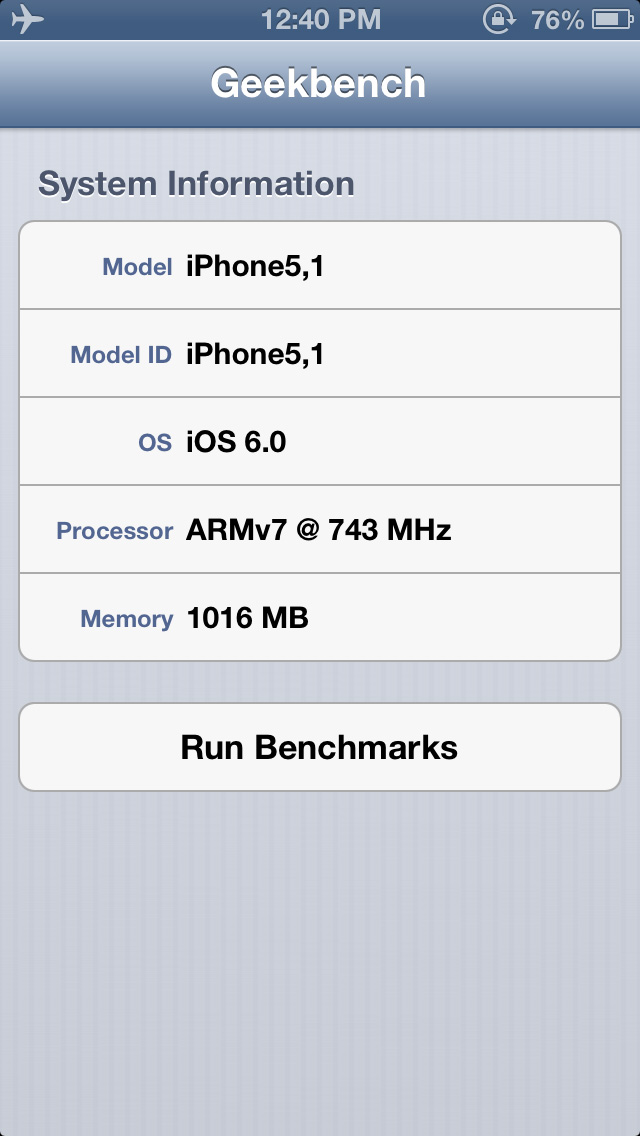
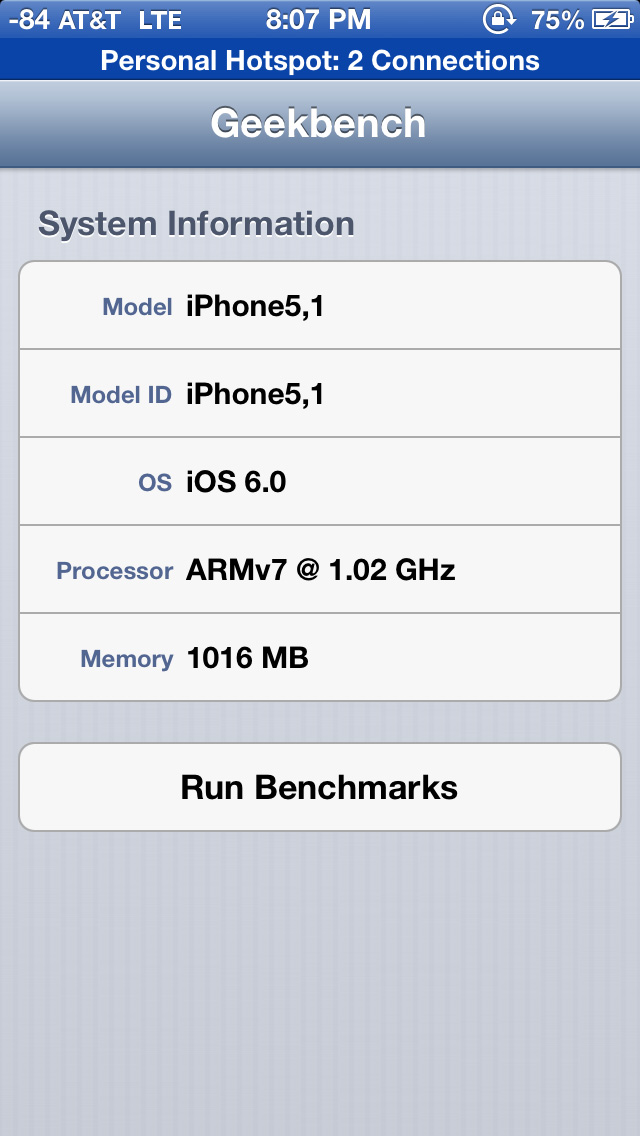
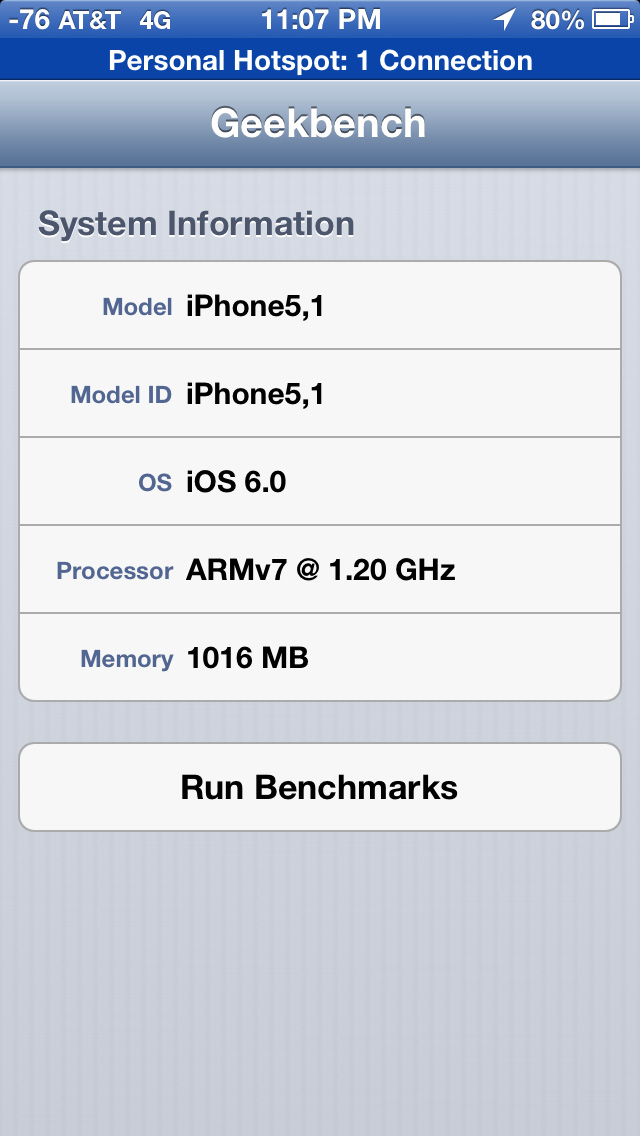
As always, our performance analysis starts out on the CPU. Although we originally thought the A6 ran its two CPU cores at 1GHz, it looks like max clocks range between 800MHz and 1.2GHz depending on load. Geekbench reports clock speed at launch, which varied depending on CPU load. With an app download process in the background I got Geekbench to report a 1.2GHz clock speed, and with everything quiet in the background the A6 reported 800MHz after being queried. This isn't anything new as dynamic voltage/frequency adjustment is in all smartphones, but we do now have a better idea of the range.
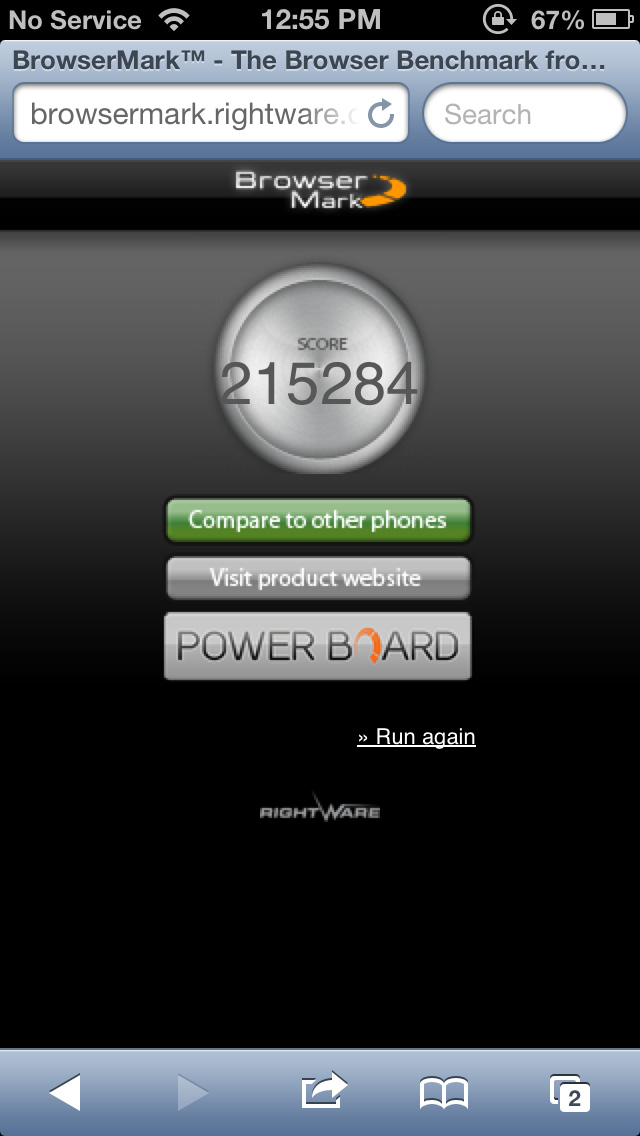
The other thing I noticed is that without a network active I'm able to get another ~10% performance boost over the standard results while on a network. Take the BrowserMark results below for example, the first two runs are without the iPhone 5 being active on AT&T's network while the latter two are after I'd migrated my account over. The same was true for SunSpider performance, I saw numbers in the low 810ms range before I registered the device with AT&T.

Clean, No Network

After Registering
Overall, the performance of the A6 CPU cores seems to be very good. The iPhone 4S numbers below are updated to iOS 6.0 so you can get an idea of performance improvement.
BrowserMark
SunSpider Javascript Benchmark 0.9.1 - Stock Browser
As we mentioned in our earlier post, SunSpider is a small enough benchmark that it really acts as a cache test. The memory interface on the A6 seems tangibly better than any previous ARM based design, and the advantage here even outpaces Intel's own Medfield SoC.
I also ran some data using Google's V8 and Octane benchmarks, both bigger JavaScript tests than SunSpider. I had an AT&T HTC One X with me while in New York today (up here for meetings this week) and included its results in the charts below. Note that the default HTC web browser won't run the full Octane suite so I used Chrome there. I didn't use Chrome for the V8 test because it produced lower numbers than the stock browser for some reason.
Google V8 Benchmark - Version 7
Google Octane Benchmark v1
Here we see huge gains over the iPhone 4S, but much closer performance to the One X. In the case of Google's V8 benchmark the two phones are effectively identical, although Octane gives the iPhone 5 a 30% lead once more.
These are still narrowly focused tests, we'll be doing some more holisitic browser tests over the coming days. Finally we have Geekbench 2, comparing the iPhone 5 and 4S:
Geekbench 2 Performance
Geekbench 2 Overall Scores Apple iPhone 4S Apple iPhone 5
Geekbench Score 628 1640
Integer 545 1252
Floating Point 737 2101
Memory 747 1862
Stream 299 946
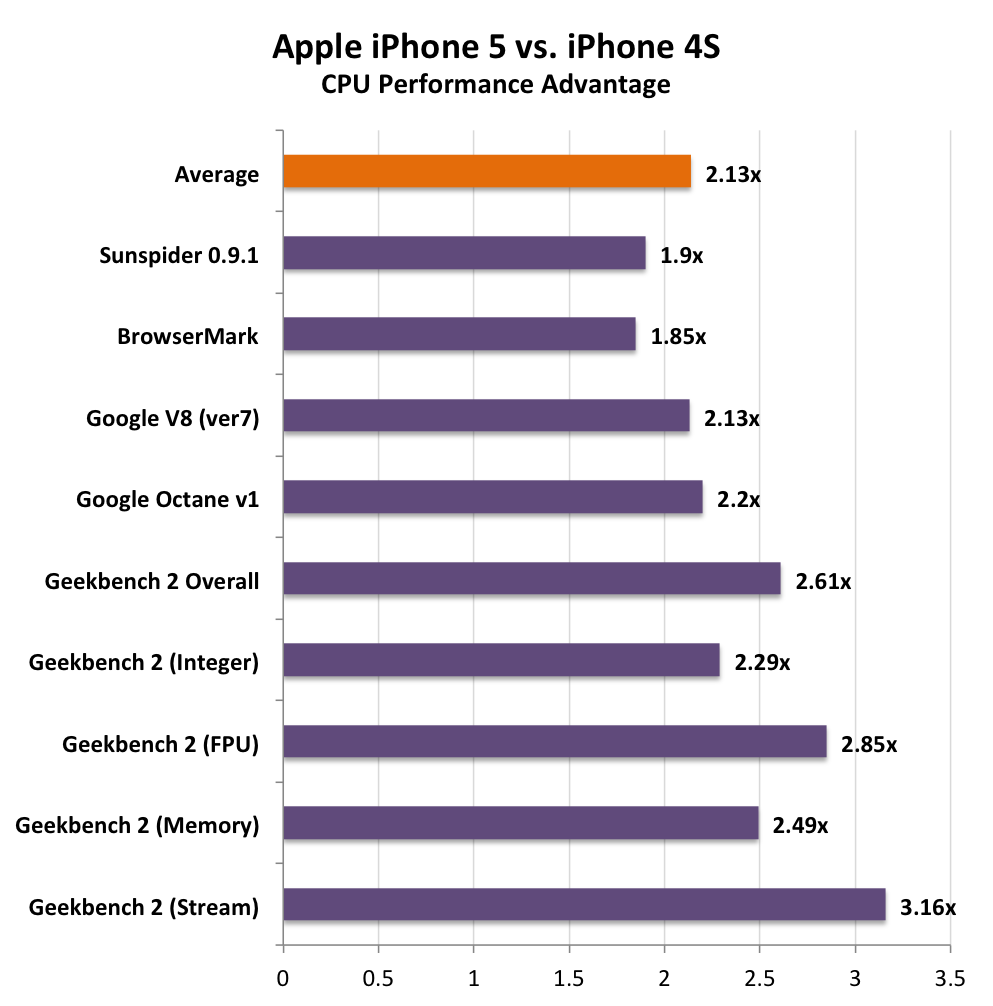
Apple claimed a 2x CPU performance advantage compared to the iPhone 4S during the launch event for the 5. How does that claim match up with our numbers? Pretty good actually:
This is hardly the most comprehensive list of CPU benchmarks, but on average we're seeing the iPhone 5 deliver 2.13x the scores of the iPhone 4S. We'll be running more application level tests over the coming days so stay tuned for those.

A6 GPU Performance: Nearly Identical to the iPad 3

Before we got a die shot of Apple's A6 we had good information pointing to a three core PowerVR SGX 543MP3 in the new design. As a recap, Imagination Technologies' PowerVR SGX543 GPU core features four USSE2 pipes. Each pipe has a 4-way vector ALU that can crank out 4 multiply-adds per clock, which works out to be 16 MADs per clock or 32 FLOPS. Imagination lets the customer stick multiple 543 cores together, which scales compute performance linearly. The A5 featured a two core design, running at approximately 200MHz based on our latest news. The A5X in the 3rd generation iPad featured a four core design, running at the same 200MHz clock speed.
The A6 on the other hand features a three core PowerVR SGX 543MP3, running at higher clock speeds to deliver a good balance of die size while still delivering on Apple's 2x GPU performance claim. The raw specs are below:
Mobile SoC GPU Comparison
Adreno 225 PowerVR SGX 540 PowerVR SGX 543MP2 PowerVR SGX 543MP3 PowerVR SGX 543MP4 Mali-400 MP4 Tegra 3
SIMD Name - USSE USSE2 USSE2 USSE2 Core Core
# of SIMDs 8 4 8 12 16 4 + 1 12
MADs per SIMD 4 2 4 4 4 4 / 2 1
Total MADs 32 8 32 48 64 18 12
GFLOPS @ 200MHz 12.8 GFLOPS 3.2 GFLOPS 12.8 GFLOPS 19.2 GFLOPS 25.6 GFLOPS 7.2 GFLOPS 4.8 GFLOPS
GFLOPS As Shipped by Apple/ASUS - - 12.8 GFLOPS 25.5 GFLOPS 25.6 GFLOPS - 12
GFLOPS
The result is peak theoretical GPU performance that's near identical to the A5X in the 3rd generation iPad. The main difference is memory bandwidth. The A5X features a 128-bit wide memory interface while the A6 retains the same 64-bit wide interface as the standard A5. In memory bandwidth limited situations, the A5X will still be quicker but it's quite likely that at the iPhone 5's native resolution we won't see that happen.
We ran through the full GLBenchmark 2.5 suite to get a good idea of GPU performance. Note that the 3rd gen iPad results are still on iOS 5.1 so there's a chance you'll see some numbers change as we move to iOS 6.
We'll start out with the raw theoretical numbers beginning with fill rate:
GLBenchmark 2.5 - Fill Test
The iPhone 5 nips at the heels of the 3rd generation iPad here, at 1.65GTexels/s. The performance advantage over the iPhone 4S is more than double, and even the Galaxy S 3 can't come close.
GLBenchmark 2.5 - Fill Test (Offscreen 1080p)
Triangle throughput is similarly strong:
GLBenchmark 2.5 - Triangle Texture Test
Take resolution into account and the iPhone 5 is actually faster than the new iPad, but normalize for resolution using GLBenchmark's offscreen mode and the A5X and A6 look identical:
GLBenchmark 2.5 - Triangle Texture Test (Offscreen 1080p)
The fragment lit texture test does very well on the iPhone 5, once again when you take into account the much lower resolution of the 5's display performance is significantly better than on the iPad:
GLBenchmark 2.5 - Triangle Texture Test - Fragment Lit
GLBenchmark 2.5 - Triangle Texture Test - Fragment Lit (Offscreen 1080p)
GLBenchmark 2.5 - Triangle Texture Test - Vertex Lit
GLBenchmark 2.5 - Triangle Texture Test - Vertex Lit (Offscreen 1080p)
The next set of results are the gameplay simulation tests, which attempt to give you an idea of what game performance based on Kishonti's engine would look like. These tests tend to be compute monsters, so they'll make a great stress test for the iPhone 5's new GPU:
GLBenchmark 2.5 - Egypt HD
Egypt HD was the great equalizer when we first met it, but the iPhone 5 does very well here. The biggest surprise however is just how well the Qualcomm Snapdragon S4 Pro with Adreno 320 GPU does by comparison. LG's Optimus G, a device Brian flew to Seoul, South Korea to benchmark, is hot on the heels of the new iPhone.
GLBenchmark 2.5 - Egypt HD (Offscreen 1080p)
When we run everything at 1080p the iPhone 5 looks a lot like the new iPad, and is about 2x the performance of the Galaxy S 3. Here, LG's Optimus G actually outperforms the iPhone 5! It looks like Qualcomm's Adreno 320 is quite competant in a phone.
GLBenchmark 2.5 - Egypt Classic
The Egypt classic tests are much lighter workloads and are likely a good indication of the type of performance you can expect from many games today available on the app store. At its native resolution, the iPhone 5 has no problems hitting the 60 fps vsync limit.
GLBenchmark 2.5 - Egypt Classic (Offscreen 1080p)
Remove vsync, render at 1080p and you see what the GPUs can really do. Here the iPhone 5 pulls ahead of the Adreno 320 based LG Optimus G and even slightly ahead of the new iPad.
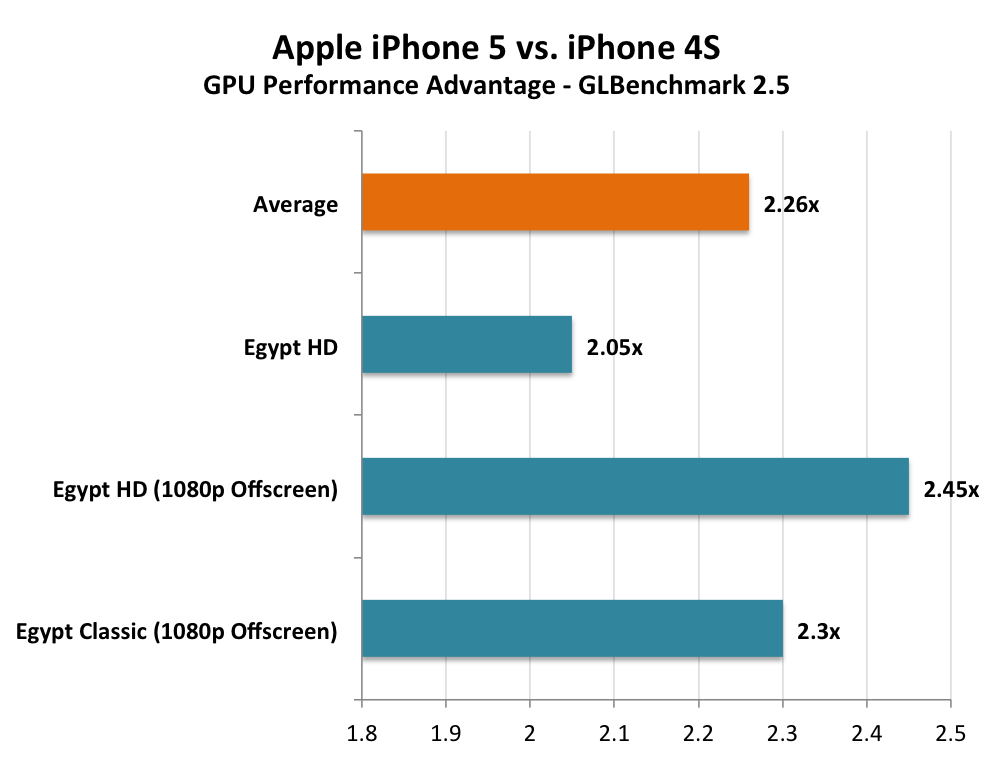
Once again, looking at GLBenchmark's on-screen and offscreen Egypt tests we can get a good idea of how the iPhone 5 measures up to Apple's claims of 2x the GPU performance of the iPhone 4S:
Removing the clearly vsync limited result from the on-screen Egypt Classic test, the iPhone 5 performs about 2.26x the speed of the 4S. If we include that result in the average you're still looking at a 1.95x average. As we've seen in the past, these gains don't typically translate into dramatically higher frame rates in games, but games with better visual quality instead.

Source: http://www.anandtech.com/show/6324/the-iphone-5-performance-preview
Read More

Thursday, December 27, 2012

iPhone 5 launches in more countries

The iPhone 5 has launched in several new countries recently, predominantly in Africa. The phone launched on December 21 in Botswana, Camaroon, Central African Republic, Egypt, Guinea, Ivory Coast, Kenya, Madagascar, Mali, Mauritius, Morocco, Niger, Senegal, St. Lucia, St.Vincent & the Grenadines, Tunisia, and Uganda, along with the islands of Barbados, St. Lucia, and St. Kitts. The iPhone 5 also went on sale in Vietnam.
Read More

Popular Posts

© 2013 TechyTeeky